

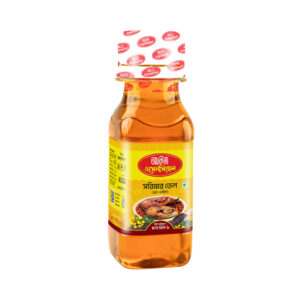
Akij Essential Mustard oil 80ml
Akij Essential Mustard Oil 80 ml is a pure, cold-pressed edible oil known for its bold aroma and pungent flavor. Widely used in traditional Bengali and South Asian cuisines, it is perfect for everyday cooking, sautéing, and pickling.
Choose quantity
Similar type of products
Description :
Eighty millilitres of cooking oil sounds like a mistake until you think about what mustard oil is actually for. It isn't the oil most households fry in daily — it's the one they reach for when a dish needs its particular sharpness. And for that, a small bottle is often the right bottle.
What cold-pressed actually means:
Mustard oil is extracted by pressing the seed mechanically, without heat. That's the traditional kachi ghani method, and it isn't merely a nod to tradition — it determines how the oil tastes.
The pungency in mustard oil comes from volatile compounds released when the seed is crushed. Heat destroys them. So an oil extracted under high temperature, or refined afterwards, loses most of the sharpness that makes mustard oil what it is.
Cold pressing keeps them intact. That's why this oil has a bite that a refined cooking oil doesn't, and why it works raw in a way a neutral oil never could.
It also means the oil is more perishable than a refined one, since the compounds that give it character are the same ones that degrade over time. Which brings us to the size.
Why a small bottle makes sense for oil:
Oil goes off, and open bottles go off faster:
Every time a bottle is opened, air gets in. Oxygen reacts with the oil, and over weeks and months that produces rancidity — a flat, stale, slightly bitter taste that no amount of spicing covers. Light and heat accelerate it.
A large bottle used occasionally is the worst case:
Opened repeatedly over six months, half-full for most of that time, sitting in a warm kitchen — that's an oil that will taste noticeably tired by the end.
A small bottle finished in a few weeks never gets there:
So for mustard oil specifically — which plenty of households use for flavour rather than as their main cooking oil — buying small isn't a compromise. It's what keeps the oil tasting the way it's supposed to.
The honest trade-off: 80ml costs more per millilitre than a 500ml or a litre. You're paying for freshness and for not committing, and whether that's worth it depends entirely on how often you cook with it.
What 80ml covers:
Roughly five to six tablespoons.
For bhorta:
that's several dishes — bhorta takes a generous spoonful, and a single bottle covers a few meals comfortably.
For pickling:
It's enough for a small jar rather than a batch.
For frying:
It's one session at most. If mustard oil is what you fry fish in, this size isn't for you and the 500ml or larger is.
Raw against heated
Worth knowing even at this size, because it changes the result completely.
Raw, the pungent compounds are at full strength — that nose-tingling sharpness is exactly what makes bhorta taste right, and what a drizzle over hot rice or dal is for.
Heated, those compounds break down and the oil mellows into something rounder and nuttier. Traditional practice is to take mustard oil to just smoking, then let it cool slightly before cooking, which removes the raw edge and leaves a cleaner flavour.
So one bottle gives two quite different results depending on whether it meets heat. For an 80ml bottle used mostly raw, that's largely academic — but worth knowing before you heat it expecting the sharpness to survive.
Keeping it from going rancid
Cap it properly, every time:
The single biggest factor is how much air gets in and stays in.
Keep it dark and cool:
Light and heat both accelerate oxidation, so a cupboard beats a windowsill and anywhere beats a shelf beside the stove.
Don't decant into a larger container:
More headspace means more air per millilitre of oil. If anything, decanting a large bottle into smaller ones as it empties is the useful direction.
The smell test is reliable:
Fresh mustard oil smells sharp and clean. Oil that's turned smells stale, flat, or faintly of old paint or crayons — and once it does, it doesn't recover. That's the point to replace it rather than cook with it.
Storing it:
Cool, dark, capped, away from the stove. That's the whole list.
One normal thing worth not worrying about: mustard oil can thicken or cloud slightly in cold weather. That reverses at room temperature and isn't a sign of anything wrong.
Frequently Asked Questions
Because oil deteriorates once opened, and a bottle finished in a few weeks never gets the chance to. If you use mustard oil for flavour — bhorta, pickling, finishing — rather than as your main frying oil, small is the size that keeps it tasting right.
Per millilitre, no — small bottles always cost more. What you're paying for is freshness and not committing to a larger bottle you'd use slowly. If you fry with mustard oil regularly, the 500ml or larger is better value and you'll finish it in time.
Several bhortas, or a small jar of pickle. Not a frying session — for that you want the larger sizes.
The seed is pressed mechanically without heat. That matters because the pungency in mustard oil comes from volatile compounds that heat destroys — so cold-pressed oil keeps the sharpness that refined oil loses.
Both work and they give different results. Raw, the sharpness is at full strength, which is what bhorta wants. Heated, it mellows into something rounder and nuttier. Traditional practice is to take it to just smoking and cool it slightly before cooking.
It breaks down the sharpest compounds, leaving a cleaner, rounder flavour. Food started in cold mustard oil tastes noticeably harsher.
Go by the date on the bottle, but in practice it's about exposure rather than time. A small bottle finished in a few weeks will taste fine throughout; a large one opened repeatedly over months won't.
Smell it. Fresh mustard oil smells sharp and clean. Rancid oil smells stale, flat, or faintly of old paint or crayons. It doesn't recover — replace it.
_10gm.gif)
_90gm.webp)