
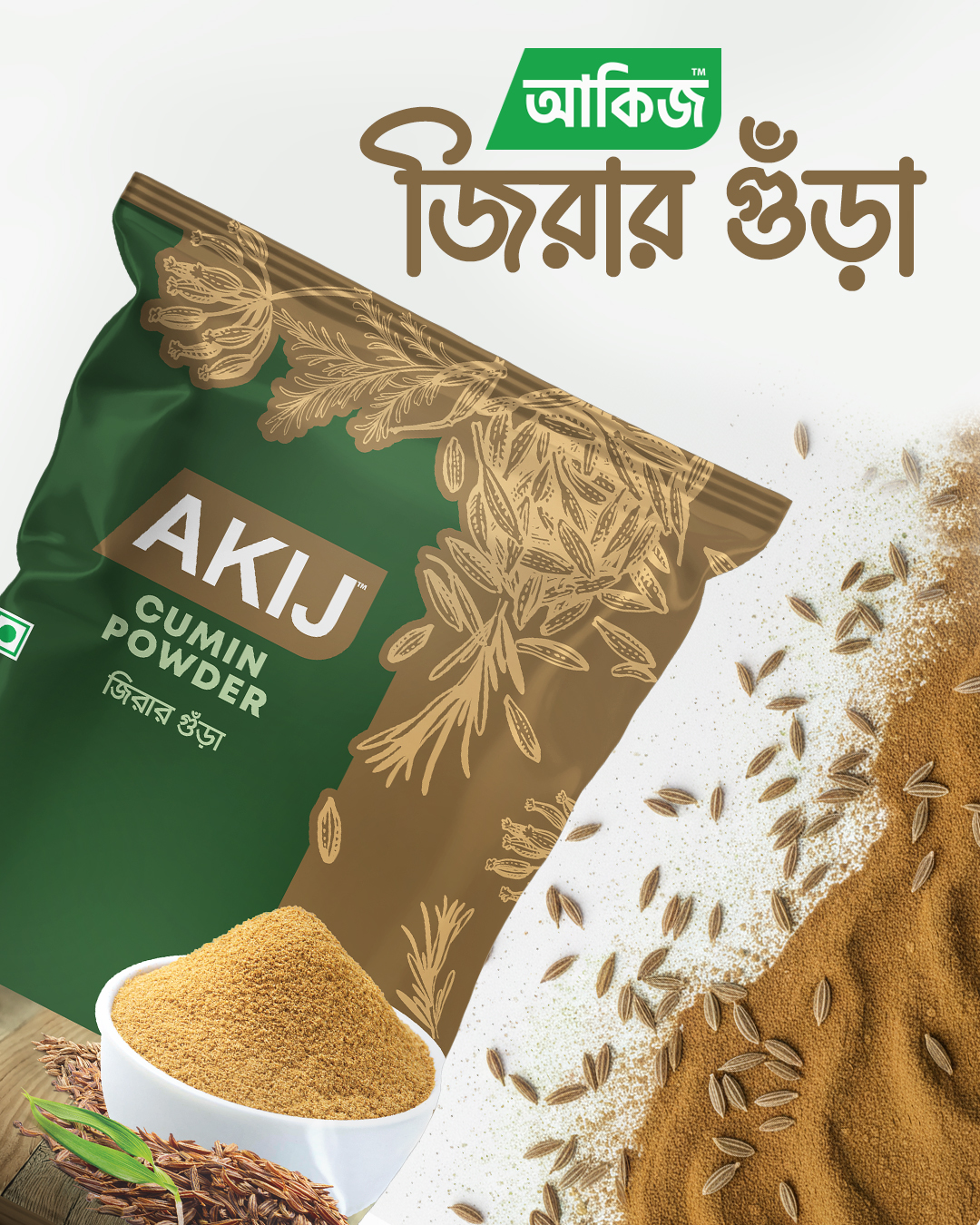
Akij Cumin Powder 100gm
Ground jeera, 100gm — warm, earthy, and the backbone of most curry masalas.
Choose quantity
Similar type of products
Description :
Akij Cumin Powder (Jeera Powder) 100 gm will improve your regular cooking. It is made from premium cumin seeds and is finely ground to preserve its flavor and perfume. It is a common spice in Bangladeshi kitchens, giving curries, biryani, veggies, and lentils a warm, earthy, and somewhat nutty flavor.
Cumin is the spice that makes a curry smell like a curry. It's in almost every masala blend sold here, it goes into biryani, dal and vegetables alike, and most kitchens get through more of it than they realise. It's also the one most often confused with two other spices that share part of its name.
Akij Cumin Powder (100 gm) is a 100% natural, hygienically packed spice known for its strong aroma and warm, earthy flavor. It retails for approximately Tk 175 and is perfect for seasoning curries, soups, and stews while offering health benefits like improved digestion.
Product Specification
• Brand: Akij
• Product Name: Cumin Powder (Jeera Powder)
• Net Weight: 100 gm
• Form: Powder
• Ingredient: 100% Pure Cumin Seeds
• Packaging: Sealed hygienic pack
• Storage Instruction: Store in a cool, dry place away from sunlight
• Usage: Suitable for curries, biryani, vegetables, lentils, and spice blends
Key Features:
• Premium Quality Cumin Seeds
• Finely Ground for Strong Aroma
• 100% Pure & Natural
• Hygienically Processed & Packed
• Ideal for Daily Cooking
Jeera, kalo jeera and shahi jeera are not the same thing:
Worth settling, because recipes use the names loosely and the three are genuinely different.
Jeera is cumin — the pale brown, ridged seed that gives this powder its warm, earthy flavour. That's what's in this pack.
Kalo jeera is nigella seed, also called kalonji or black seed. Small, matte black, and completely unrelated to cumin botanically. It tastes sharper and slightly bitter, and it's used whole — in panch phoron, scattered on bread, tempered into vegetables. Ground nigella is not a substitute for cumin powder in any dish.
Shahi jeera is a third seed again, darker and thinner than cumin, with a more intense and slightly sweeter aroma. It appears in richer preparations — biryani, korma — in small quantities.
The practical point:
If a recipe calls for jeera, it means cumin. If it calls for kalo jeera, substituting cumin changes the dish completely. The names overlap; the spices don't.
Why cumin costs more than chilli or turmeric:
At around BDT 1,520 a kilo, this is roughly double what Akij charge for chilli or turmeric powder at the same size.
That gap is normal across the category rather than specific to one brand. Cumin seed is a more expensive raw material — lower yields, more of it imported, and a less forgiving crop than chilli or turmeric.
The useful consequence is that cumin rewards careful buying more than the cheaper spices do. Buying a kilo of chilli and losing some to staleness costs little. Doing the same with cumin costs considerably more, which is an argument for buying a size you'll finish rather than the lowest price per kilo.
Ground against whole:
This matters more with cumin than with most spices.
Whole cumin seeds keep their aroma far longer than ground cumin. The volatile oils that carry the flavour are protected inside the seed; grinding exposes all of it to air at once. A jar of whole cumin is still fragrant after a year. Ground cumin is noticeably flatter after six months.
So why buy ground at all?
Convenience, consistency and the fact that most everyday cooking calls for powder rather than seeds. A curry base wants cumin dispersed through the gravy, not whole seeds sitting in it.
Plenty of kitchens keep both:
Whole seeds for tempering, where the seed is meant to be visible and to pop in the oil, and powder for everything blended into a masala.
Making bhaja jeera:
This is the thing worth knowing, because roasted cumin powder is a different ingredient from raw ground cumin, and it's used across Bengali cooking.
Dry-roasting transforms it:
Heating cumin without oil, over low heat, until it darkens a shade and the smell changes from raw and grassy to deep and nutty — that's bhaja jeera, and it goes into borhani, doi, raita, chaat, jhalmuri and salad.
If you have whole seeds:
Roast them in a dry pan for two or three minutes, shaking constantly, then cool and grind. That's the proper method and the result is noticeably better.
If you only have powder:
You can approximate it — a minute in a dry pan over the lowest heat, moving it constantly. It burns far faster than whole seeds do, so this needs watching rather than timing. Pull it off as soon as the smell changes.
Don't use bhaja jeera where a recipe wants raw cumin powder, or the other way round. Roasted cumin is sharper and more forward; raw cumin blends into a base. They do different jobs.
When to add cumin in cooking:
Early, in the oil with the onions, when it's going into a curry base. Cumin is one of the spices that benefits most from blooming — the warm, earthy character develops properly in fat and barely at all in water.
Late or raw, when it's bhaja jeera finishing a dish — sprinkled over borhani, stirred into yoghurt, dusted onto a salad. Here you want the roasted aroma intact rather than cooked out.
Never scorched. Cumin burns quickly and burnt cumin is acrid in a way that can't be fixed. Twenty to thirty seconds in warm oil is plenty.
How much to use:
For a curry serving four: one to two teaspoons of cumin powder, usually alongside coriander in roughly equal measure. Cumin and coriander together form the backbone of most everyday masalas here, with coriander providing body and cumin the aroma.
A level teaspoon weighs roughly 2.5 grams, so 100gm is around forty teaspoons — twenty to forty dishes, or two to three months of regular cooking.
Frequently Asked Questions
It is commonly used in curries, biryani, dal, vegetables, and meat dishes to enhance flavor and aroma.
Yes, it is made from 100% pure cumin seeds with no added colors or preservatives.
It is produced using cold-pressed technology and undergoes strict lab testing to ensure quality, purity, and authentic taste.
We have 24 outlets all over Bangladesh. Please visit our stores: https://www.metromartonline.com/outlets
Yes, we provide home deliveries in all over Bangladesh.
They're completely different spices. Jeera is cumin — pale brown, ridged, warm and earthy. Kalo jeera is nigella seed, small and matte black, sharper and slightly bitter, used whole. Substituting one for the other changes a dish entirely.
A third seed again — darker and thinner than cumin, more intense and slightly sweeter. It appears in richer dishes like biryani and korma, in small quantities. Not interchangeable with ordinary cumin.
Cumin seed is a more expensive raw material — lower yields, more of it imported, and a less forgiving crop. The gap is normal across the category rather than specific to any brand.
Both have a place. Whole seeds keep their aroma far longer, because the volatile oils stay protected inside the seed, and they're what you want for tempering. Powder is what most everyday cooking calls for, where cumin needs to disperse through a gravy. Many kitchens keep both.
Considerably. Whole cumin is still fragrant after a year; ground cumin is noticeably flatter after six months. Grinding exposes all the aromatic oil to air at once.
Roasted cumin powder — cumin dry-roasted until it darkens and the smell turns deep and nutty, then ground. It's a different ingredient from raw ground cumin and goes into borhani, doi, raita, chaat and jhalmuri.
You can approximate it — a minute in a dry pan over the lowest heat, moving constantly. It burns far faster than whole seeds, so watch it rather than timing it, and pull it off as soon as the smell changes. Starting with whole seeds gives a noticeably better result.
Not interchangeably. Roasted cumin is sharper and more forward; raw cumin blends into a base. Using one where the recipe wants the other is noticeable.