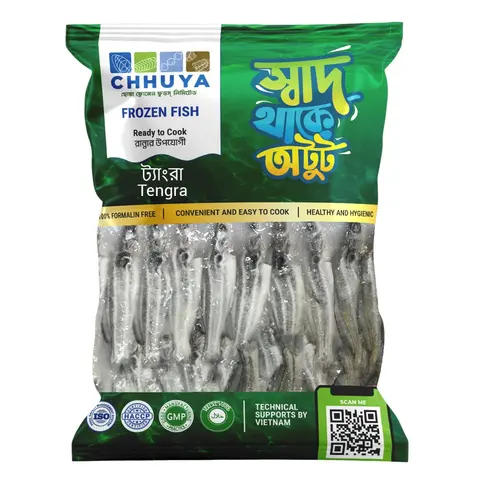
Description :
Most small freshwater fish ask to be handled gently. Tengra doesn't. It has a bold, slightly muscular flavour and flesh firm enough to hold together through a long simmer, which is why Bengali cooks reach for it when they want a dish with some force behind it — a sharp jhal, a tamarind-soured gravy, a curry heavy with mustard oil and green chilli.
It's the striped one, easy to recognise: a small scaleless catfish with dark bands along its sides. Chhuya Tengra comes frozen in a 500g pack.
Why cooks keep coming back to it
Tengra earns its place through reliability. It doesn't disintegrate the way softer fish do, so you can build a gravy around it without watching the pan anxiously. Its flavour doesn't vanish under spice, so it works in preparations that would overwhelm a more delicate fish. And it's available in a way that scarcer catfish aren't — this is a fish people cook regularly rather than occasionally.
Scaleless skin means no descaling. One less job before you start.
The tamarind tradition
Tengra with tamarind — tetul diye tengra — is one of those pairings that sounds odd until you've eaten it. The sourness cuts against the fish's richness and lifts the whole dish, and it's a combination that only really works with a fish assertive enough to hold its own. Try it with a delicate fish and the tamarind simply takes over.
If tamarind isn't to hand, brinjal does related work. Tengra with begun is probably the most cooked version of this fish in Bangladeshi homes, the vegetable soaking up the gravy while the fish keeps its shape.
Ways to cook it
Tengra macher jhal — mustard paste, green chilli, mustard oil, cooked down sharp and concentrated.
Tetul diye tengra — the tamarind version, sour and bright.
Tengra begun diye — with brinjal, the everyday household preparation.
Shorshe tengra — a straightforward mustard gravy, heavier-handed than you would dare with pabda or gulsha.
Tomato and coriander jhol — lighter, cleaner, good for a hot day.
Brown the fish briefly in hot oil before it goes into any gravy. Tengra takes this better than most small fish and comes out the better for it.
A note on handling
Like most catfish, tengra carries sharp spines on its dorsal and pectoral fins. There's no hazard once the fish is cooked, and none of the drama of handling a live one, but it pays to be unhurried when you're washing and portioning the raw fish.
Keeping it and thawing it:
Store the pack at -18°C and leave it there until the day you plan to cook. Move it to the refrigerator the night before and let it come round slowly — this is the method that costs you least in texture. Where that isn't possible, sit the unopened pack in a bowl of cold water and refresh the water every twenty to thirty minutes until it gives. Warm water is a false economy: it thaws the outside into the temperature range bacteria prefer while the middle is still solid.
Dry the fish well before it meets oil. Cook it within a day of thawing, and don't return thawed fish to the freezer.
Buying it:
Set your quantity, pick a delivery location, and pay through any of the secure methods at checkout. The pack should go into your freezer promptly once it reaches you.